Thoughts on Poor Folk by Fyodor Dostoevsky
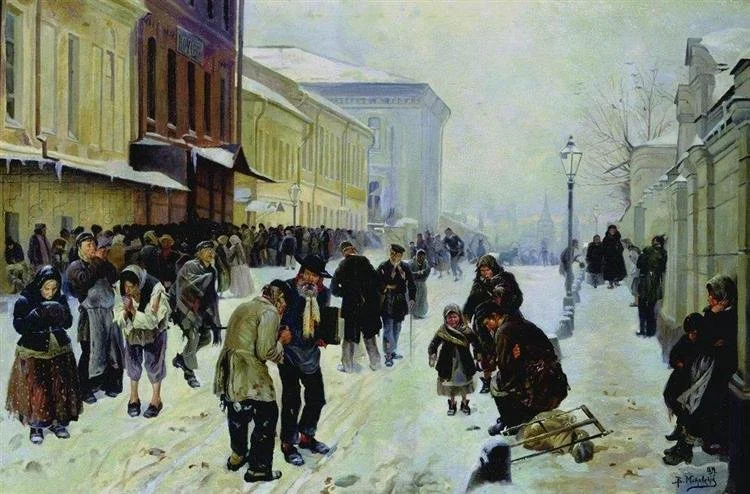
The Doss House, Vladimir Makovsky, 1889
What Are You Really Called To?
The forgotten art of discerning your vocation — and finding freedom within it
✦ ✦ ✦
There is a question most of us carry quietly — sometimes for years. It surfaces on Sunday evenings when the week ahead feels hollow, or in the middle of a meeting when you wonder: Is this actually what I'm meant to be doing?
The pursuit of personal calling has become a modern obsession. We attend workshops, read memoirs, and scroll through curated lives looking for clues about our own. But what if the most profound insight on this subject didn't come from a TED Talk or a self-help bestseller — but from a 19th-century Russian novel about two impoverished letter-writers?
Fyodor Dostoevsky's Poor Folk is not an obvious place to seek career clarity. And yet buried in the tender, desperate letters between Makar Devushkin — a humble government clerk — and the young seamstress Varvara Dobroselova lies a framework for evaluating calling that our self-optimization culture has almost completely forgotten.
1. Your Calling May Already Be a Gift
Devushkin is not a man the world would call successful. He copies documents for a living, lives in a cramped apartment, and sacrifices his own meals to send small gifts to Varvara - the woman he loves. And yet he carries something rare: a genuine sense that his place in the world is not accidental.
He writes: "Every station that falls to a man's lot in this world is ordained by the Almighty" (66).
This is not passivity. This is not defeat. This is a man who has found dignity within his circumstances — something that no promotion, no lateral career move, and no personal brand overhaul can manufacture.
Ask yourself honestly: Have you ever paused long enough to consider whether your current role — unglamorous as it may feel at times — might be exactly where your particular gifts are most needed? Not every calling is a stage. Some are quiet rooms and mundane tasks.
2. Contentment Is Not the Enemy of Ambition
Varvara writes to Devushkin with a kind of hard-won wisdom: "Be a decent man, steadfast in misfortune; remember that poverty is not a sin" (92).
Modern culture treats contentment with suspicion - even in the church. We mistake it for giving up or, more likely, the sign of complacency and faithlessness. Almost as if the stage of contentment pushes against the Great Commission mandate to “make disciples of all nations” (Mt 28:19). We think that if you're not restless, you're not growing. But Dostoevsky understood something deeper: contentment and character are inseparable. The person who cannot find meaning in this circumstance will rarely find it in the next one either.
The question to sit with: Is your desire for a different calling rooted in genuine conviction — or in the discomfort of showing up fully where you already are?
3. Calling Is Revealed Through Community, Not Isolation
One of the most beautiful things about Poor Folk is that calling is never discovered in a vacuum. Devushkin finds his fullest sense of self not in solitude or self-reflection, but through his relationship with Varvara. He writes to her:
"When you came my way you lit up the whole of my dark life, so that my heart and my soul were illumined... I was a human being, with the thoughts and feelings of a human being" (94)
Purpose, it turns out, is not always something you find by going inward - it rarely is. Often it finds you through the Spirit’s leading in other people’s advice. One of the beautiful parts of the church’s fellowship is the guidance and wisdom in discerning one’s calling. Though others advice is not the be-all and end-all, take note of the encouragement and thoughts of others. The Lord may very well be speaking through them.
4. Beware the Escape That Masquerades as a Calling
Here is where Dostoevsky becomes genuinely prophetic. Varvara, despite her own wisdom about steadfastness, ultimately makes a choice driven not by calling but by fear. She agrees to marry a wealthy man she does not love, writing: "If there is anyone who can save me from my shame, restore to me my honourable reputation, and rescue me from poverty, deprivation and unhappiness, it is him, and him alone" (119).
Notice the language: save, rescue, restore. This is not the language of calling. This is the language of flight.
We do this too. We call it a pivot. A reinvention. A bold new chapter. And sometimes it genuinely is. But other times, we are simply running from discomfort and dressing it in the language of destiny. The grief Devushkin feels — "And who will I have once you are gone?" (121) — is the collateral damage of a calling abandoned for comfort.
Before you make a major life change in the name of purpose, ask: Am I moving toward something, or away from something? Has the Lord called me to this, or am I running from what I am truly called to? The distinction is everything.
5. True Calling Flows From God, Not Simply What You Want to Become
The novel's final, devastating letter from Devushkin is a masterclass in authentic voice. He writes frantically and vulnerably, fully aware that he's losing coherence: "I write only in order to write, only in order to write as much as possible to you" (129).
This is what genuine calling looks like stripped of performance: not polished, not strategic, not optimized for the audience at hand. Just the compulsion to do the thing because not doing it is unbearable.
What would you do if you stripped away the resume-building, the opinions of others, and the curated narrative? What remains? What is it that you sense the Lord calling you to do that is “exceedingly abundantly above all that we ask or think” (Eph 3:20) ? That remainder is worth taking seriously.
✦ ✦ ✦
A Final Word
The poor folk of Dostoevsky's novel never achieved greatness by any conventional measure. They were not promoted. They did not pivot into fulfilling careers. One was left behind; the other was swept into a loveless marriage.
And yet Dostoevsky clearly believes their lives — and the values they embodied at their best — matter profoundly. That steadfastness in misfortune is not failure. That love given freely within a humble station is not small.
Evaluating your personal calling is not a one-time exercise. It is a lifelong practice of asking: Am I being faithful to the life I have been given? Am I running toward or running away? Am I doing this because it's my calling, my purpose — or because it looks good from the outside?
Dostoevsky, writing in 1846, had no life coach certification. But he understood that the examined life is not one spent restlessly seeking a better station — it is one spent asking, with honesty and humility, whether you are truly present in the one you already occupy.
The Lord has a plan for each of our lives with distinct roles, special influences, and special opportunities. Embrace what God has called you to do. Because you are the only one who can do it!
No one longs to come to the end of his life realizing that they have failed to live out their sacred calling.
Embrace your calling in all its joys, sorrows, and in-betweens, and you will find there is no greater life to live.